CONTACT AND INFORMATION
Felix Sodemann
theaterpreis@iti-germany.de
In 2019, the Federal Theater Prize was awarded for the third time.
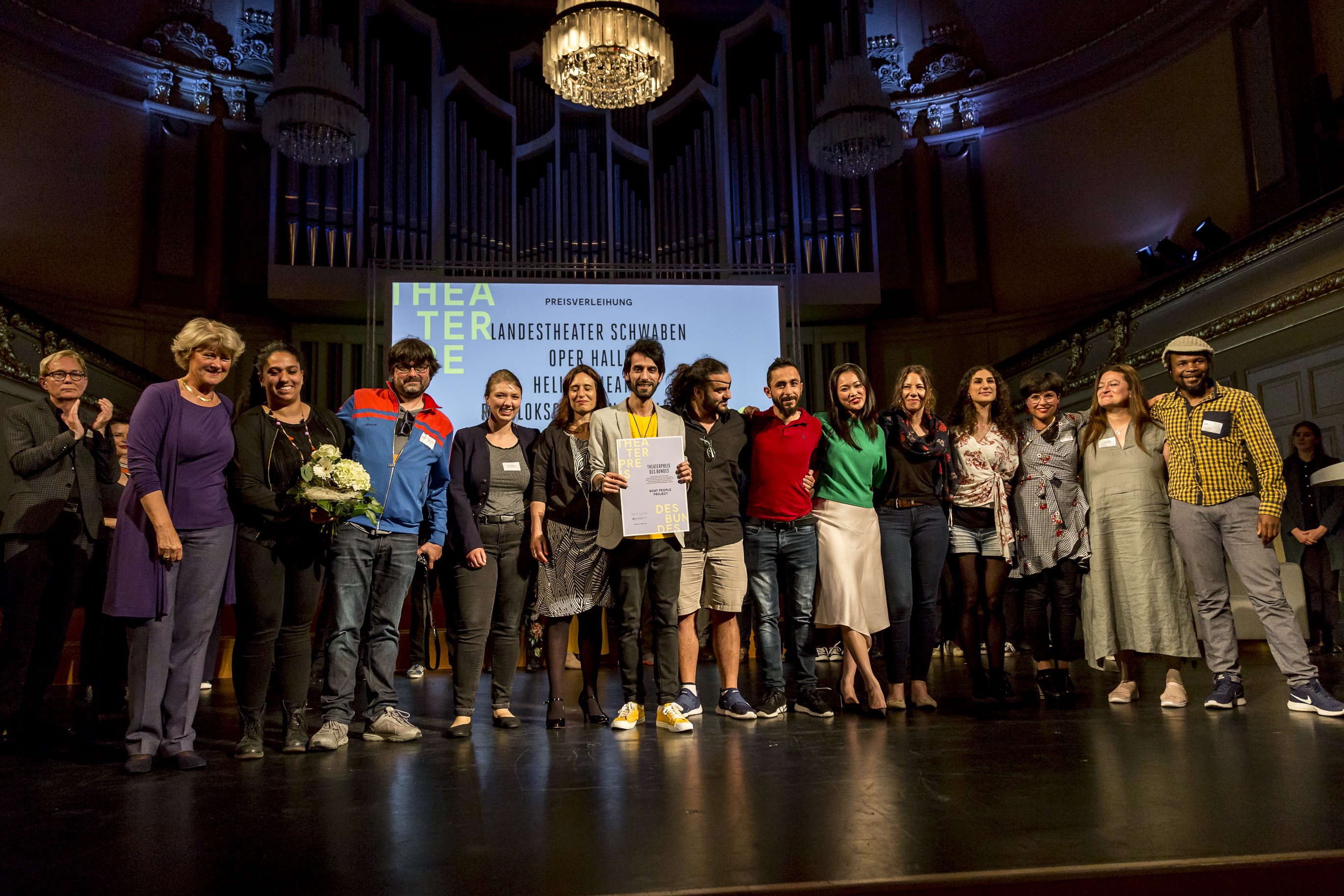
The prize is aimed at small and medium-sized theatres that have an impact on urban society with their cultural offerings, theater productions, guest performances and participatory projects. The focus should be on theatres outside the metropolises, away from the theatre centres. And so only two theatres from cities with more than 300,000 inhabitants are among the prize winners. In addition to nationwide attention, this also means 75,000 € for artistic projects, which will go to each theatre.
Click here for the complete press release of the German office of the International Theatre Institute and for the press release of the Minister of State for Culture and Media Prof. Monika Grütters.
On May 27, 2019, the prize ceremony of the Federal Theatre Prize 2019 and the conference "Dialogue with the urban society" took place at the Theater Gera.
The conference, which was hosted by the ITI as part of the prize ceremony, brought around 120 participants from all areas of the theatre landscape into an intensive dialogue. Keynote speeches by the cultural researcher Hilke Berger and Wolfgang Schneider from the Institute for Cultural Policy at the University of Hildesheim kicked off the discussion. Hilke Berger in particular with a critical look at the concept of participation; Wolfgang Schneider with an all-round look at cultural policy initiatives for "theatre in the province", which should not only focus on the municipal theatre, but also on the independent scene and amateur theatre.
Then 13 discussion groups led from theory into practice, which concretely brought projects of the prize winners and of houses that had applied for the theatre prize into conversation. Examples: The great role played by long-term mediation work was made clear by the example of the Gera Theaterfabrik; how an audience is reached through concrete engagement with Flensburg's city history was shown by the Theater Pilkentafel; what staying power it takes to involve the citizens of a city in the project "Staging Democracy" was reported by the Lichthof Theater from Hamburg; how really topical plays for children are created because the separation of theatre makers and theatre pedagogy is abolished in the Piccolo Theater Cottbus; how an inclusive project becomes a theatre work with its own artistic quality - this experience was shared by the Theater Thikwa from Berlin. A summary of all discussion groups will be part of the documentation.
The second part of the conference under the title "Theatre under Pressure?" confronted the theatre associations with three impulses, which demanded from the theatres not only the dialogue with the urban society, but also the associated, necessary change of perspectives and structures in the houses. Laura Kiehne (ensemble network) and Sören Fenner (art but fair) made an urgent plea for fair pay and fairer structures at the theatres. Marc Grandmontagne (Deutscher Bühnenverein), Dorothee Starke (INTHEGA) and Anne Schneider (Bundesverband Freie Darstellende Künste) did not want to close their minds to this demand. Above all, because they all saw great potential in a theatre freed from traditional hierarchies and enriched by respect and artistic dialogue at eye level, also for dialogue with urban society. Christophe Knoch (Die Vielen) also focused on this open theatre that engages with society. Enabling social groups to participate in the theatres' cultural offerings also means participating in what is being discussed in society. Dorothee Starke expressly invited Knoch to the next INTHEGA conference and showed here, as in other statements, that the guest performance theatres are another pillar of the theater landscape that must be taken seriously.
For the International Theatre Institute (ITI), Kay Wuschek brought it down to these two points: Theaters should be involved in society, should listen and participate in what social issues and cultural community mean to others. And they should not see this as making up for deficits, but as a great potential for their artistic development.
An outlook that gives courage and strength, also in view of the questions that also dominated the discussion with the European elections (and the local elections in Thuringia). "Art is free and it will always remain so", was the core sentence of the speech by Minister of State for Culture Monika Grütters at the subsequent prize ceremony. Monika Grütters praised the artistic achievements of the prize winners as an example of the great diversity of the theatre landscape. A diversity that is made possible by the states and municipalities, and in which artists repeatedly provide food for thought on social issues.
Gera's mayor Julian Vonarb and Thuringia's Minister of Culture Benjamin-Immanuel Hoff expressed their commitment and strong statements about the need to create political attitudes, support and a social climate for this at local level.
The 31 theatres that were awarded the Federal Theatre Prize in 2015, 2017 and 2019 are portrayed in the magazine "Stadt, Land, Kunst - Theater im Dialog mit der Gesellschaft an den Rändern der Städte und jenseits der Metropolen" (City, Country, Art - Theater in Dialogue with Society on the Fringes of Cities and Beyond the Metropolises).
Produced in collaboration between the German Centre of the International Theatre Institute and the editorial team of Theater der Zeit, the special publication is now included in the May 2020 issue of Theater der Zeit. Authors from the theatres present the work of small and medium-sized theatres in individual studies. These portraits are complemented by two roundtable discussions that examine the role of the prize both from the perspective of theatres that have not yet been able to win the prize and from the viewpoint of representatives of the theatre associations.
The supplement to Theater der Zeit also includes a brief evaluation of a survey on how the Federal Theater Prize is perceived among theatre professionals and what effects are attributed to the prize in the theatre world.
The digital version of the special publication is available free of charge here.